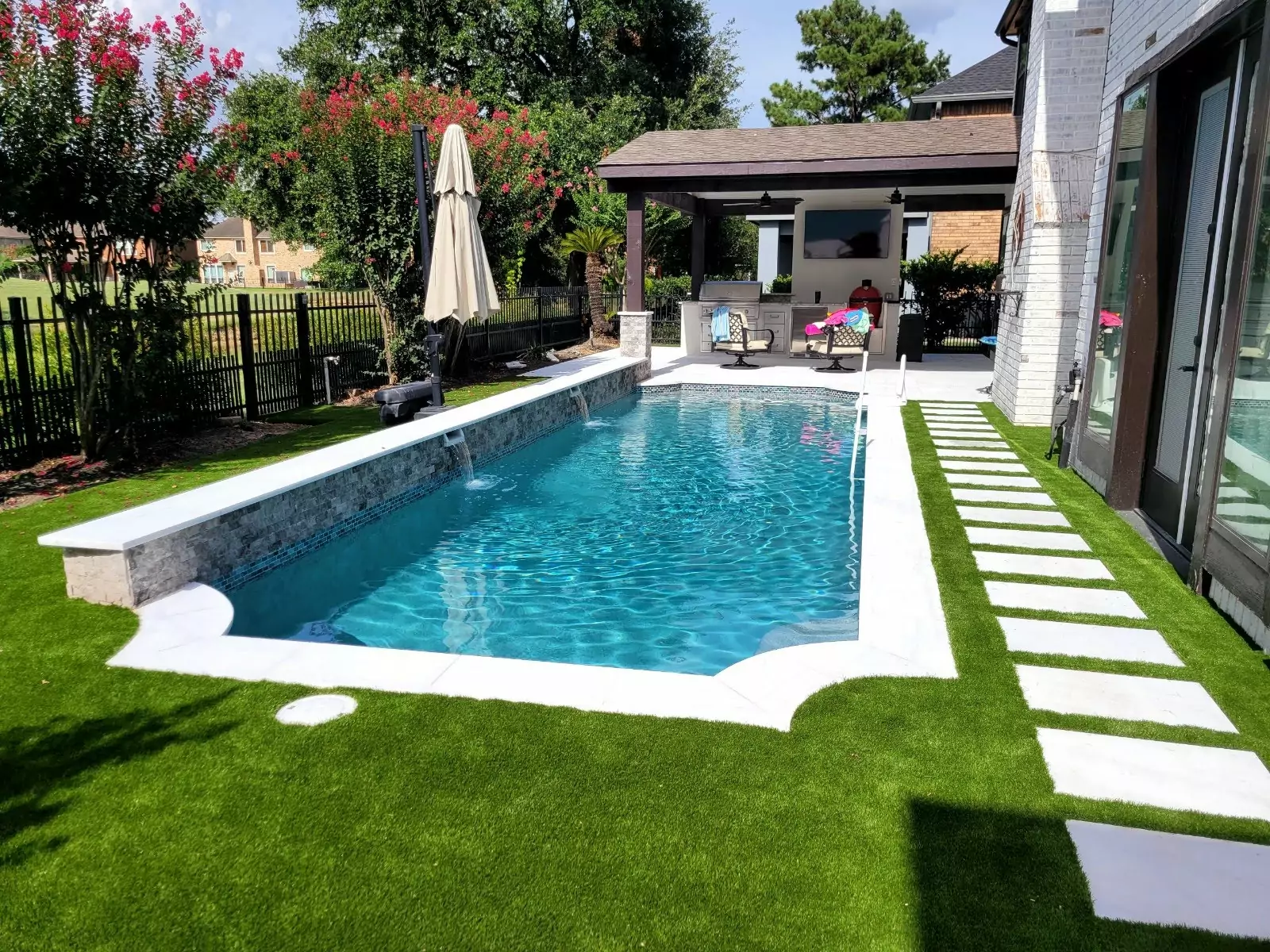
You've decided you want a pool. You've got a backyard, a budget, and a general idea of what you want it to look like. And then someone — a neighbor, a contractor, a YouTube video — introduces the gunite versus fiberglass question and suddenly a decision that felt straightforward has a lot more variables than you expected.
Both pool types are legitimate. Both have been built in Texas backyards for decades. Both can look stunning when done well. But they perform differently in Texas conditions, they cost differently, they feel different to own long-term, and the right answer depends on factors that are specific to your yard, your soil, your budget, and how you intend to use the pool. The homeowner who chooses gunite for the right reasons and the homeowner who chooses fiberglass for the right reasons both end up happy. The homeowner who chooses either one without understanding the real differences often ends up wishing they'd asked more questions before breaking ground.
This guide gives you the honest, Texas-specific comparison that most pool contractors won't sit down and walk you through — because CK Pools believes the homeowner who understands what they're buying makes a better client and ends up with a better pool.
Before comparing performance, cost, and ownership experience, understanding how each pool type is actually constructed explains why they behave differently.
How gunite pools are built: Gunite — and its close relative shotcrete — is a concrete construction method where a mixture of cement, sand, and water is sprayed under high pressure over a steel rebar framework that's been shaped to the pool's design. The concrete conforms to whatever shape the steel framework defines, then cures into a monolithic shell that's essentially a custom-shaped concrete vessel. After the shell cures, the interior is finished with plaster, pebble aggregate, quartz, or tile — the finish layer that you actually see and touch when you're in the pool.
The gunite construction process happens on your property, in your backyard, over a period of weeks. Every gunite pool is built from scratch to the exact dimensions and shape of the design — there's no standard size or shape, no factory template, no limitation on what can be built.
How fiberglass pools are built: A fiberglass pool is a one-piece shell manufactured off-site in a factory — fiberglass layers are applied over a mold to create a shell in a specific shape and size. The finished shell is transported by truck to the installation site, where a crane lifts it over the house or fence and sets it into an excavated hole. Plumbing connections are made, the space around the shell is backfilled, and the pool is filled with water.
The fiberglass manufacturing process happens in a controlled factory environment. Every fiberglass pool of a given model is built from the same mold — which means shapes, sizes, and features are limited to what the manufacturer offers. A fiberglass pool buyer chooses from a catalog; a gunite pool buyer designs from scratch.
Texas creates specific performance demands that affect how gunite and fiberglass pools hold up — and understanding these demands is where the comparison gets Texas-specific in ways that general pool comparison articles don't address.
Clay soil movement — gunite's advantage in North Texas.
This is the single most important Texas-specific factor in the gunite versus fiberglass comparison — and it points toward gunite for North Texas homeowners in particular.
Dallas, Fort Worth, and the surrounding markets sit on expansive clay soils that shift dramatically with moisture changes. When soil is wet, it expands. When it dries, it contracts. This movement is measurable — active clay soils in North Texas can move vertically by inches across a single wet-to-dry cycle. That movement puts stress on every structure embedded in the ground — including pool shells.
Gunite pools handle clay soil movement significantly better than fiberglass pools for a fundamental structural reason: a gunite shell is rigid concrete reinforced with steel rebar that resists the deforming forces soil movement creates. When soil pushes against a gunite shell from the outside, the shell's mass and reinforcement resist the force. Hairline surface cracks can develop over time from sustained movement — and CK Pools addresses these as part of ongoing service — but the structural integrity of a properly engineered gunite shell in North Texas clay is well-established through decades of successful installations.
Fiberglass shells are designed to flex — the fiberglass material has inherent elasticity that allows some degree of flexing without cracking. In stable soil conditions, this flexibility is a performance advantage. In North Texas clay conditions, where soil movement exerts sustained directional pressure against the pool shell, fiberglass flexibility can work against the pool — a shell that flexes under soil pressure can distort, develop stress fractures at fittings, and in severe cases warp enough to affect the pool's appearance and function. Fiberglass pool installations in North Texas require specific engineering — proper backfill material, careful compaction, and drainage management — to minimize the soil movement forces the shell experiences. When this engineering is done correctly, fiberglass can perform adequately. When it's not, the results are expensive.
CK Pools' recommendation for Dallas, Fort Worth, and surrounding North Texas markets is gunite — the structural characteristics of a properly engineered concrete shell are simply better suited to the soil movement demands of this environment than fiberglass.
Hard water and surface chemistry — fiberglass's advantage.
Texas fill water is mineral-heavy, and pools in San Antonio, Austin, Houston, and most other Texas markets deal with high calcium hardness that creates scaling pressure on pool surfaces. This is where fiberglass has a meaningful performance advantage over gunite.
Fiberglass pool surfaces are non-porous — the gelcoat surface that forms the interior of a fiberglass pool doesn't absorb water, minerals, or staining agents. Calcium scale deposits on fiberglass surface rather than infiltrating the surface material — which makes it easier to clean and prevents the mineral damage that occurs in plaster surfaces when calcium chemistry isn't actively managed.
Gunite pools finished with plaster — the most common and most affordable gunite interior finish — are porous and susceptible to calcium etching and mineral infiltration when water chemistry drifts out of range. A gunite pool with plaster interior that experiences chronic high calcium hardness or pH swings will show surface deterioration faster than a fiberglass pool under the same chemistry conditions.
Gunite pools finished with pebble aggregate or quartz are significantly less susceptible to this issue — the denser aggregate materials resist calcium infiltration better than standard plaster. For Texas homeowners choosing gunite, a pebble or quartz interior finish is worth the incremental cost specifically because of Texas hard water conditions.
UV exposure — negligible difference.
Both gunite and fiberglass pool materials handle Texas UV exposure adequately when properly manufactured and finished. UV degradation of pool surfaces is not a meaningful differentiator in the Texas gunite versus fiberglass comparison.
Temperature cycling — slight fiberglass advantage.
Texas pools experience significant temperature cycling — water temperatures ranging from near 50 degrees in winter to 90+ in summer, with equipment area temperatures even more extreme. Fiberglass's inherent flexibility handles thermal expansion and contraction slightly more gracefully than rigid concrete — fiberglass pools rarely develop the surface crazing from thermal cycling that can appear in older plaster finishes.
This difference is minor and manageable in gunite pools with modern pebble or quartz finishes — it's more significant for gunite pools with standard plaster interiors that are more susceptible to crazing from thermal stress.
This is the most straightforward part of the comparison: gunite pools can be built in any shape, any size, and any configuration imaginable. Fiberglass pools can be built in whatever shapes the manufacturer's mold catalog includes.
What gunite design freedom actually means:
A gunite pool can be any shape — freeform organic curves, geometric rectangles, L-shapes, kidney shapes, lagoon shapes, or completely custom designs that exist nowhere else. It can be any size — from a compact 10x20 pool for a small yard to a 20x50 lap pool for serious swimmers. It can incorporate any combination of features — sun shelves at any depth and any dimensions, grottos, infinity edges, vanishing edges, tanning ledges, and beach entries — all built to exact specifications.
A gunite pool can have a spa integrated into the design from the start, positioned wherever makes the most design sense, connected to the pool however the circulation design requires, and finished to match the pool interior perfectly.
What fiberglass design limitations actually mean:
A fiberglass pool buyer chooses from a catalog of available shapes and sizes. That catalog has expanded significantly in recent years — quality fiberglass manufacturers now offer dozens of shapes and sizes with various built-in features. But the catalog is finite. A homeowner who wants a specific shape, a specific size, a specific sun shelf dimension, or a specific feature configuration that doesn't exist in the manufacturer's lineup cannot build that pool in fiberglass.
For Texas homeowners with unusual yard configurations — odd shapes, slopes, constraints from mature trees or existing structures — the ability to design a gunite pool specifically to fit the available space is often the deciding factor. A fiberglass shell that's 14 feet wide doesn't fit in a space that needs a 12-foot pool.
This is fiberglass's clearest operational advantage — the installation timeline is dramatically shorter than gunite.
Fiberglass installation timeline: The fiberglass shell arrives on a truck, is set by crane, plumbing is connected, backfill is placed, and the pool is filled with water. From excavation to water in the pool, a straightforward fiberglass installation typically takes 1–3 weeks.
Gunite installation timeline: Gunite pool construction proceeds through multiple phases — excavation, steel installation, plumbing rough-in, gunite application and curing, tile and coping work, deck construction, equipment installation, interior finish application, and water startup. From breaking ground to first swim, a typical gunite pool takes 8–16 weeks depending on complexity, permitting, and weather.
For Texas homeowners who are building with a specific timeline in mind — wanting the pool ready for a summer the permits are pulled in spring — the installation timeline difference is meaningful. Fiberglass can realistically go from permit to swim in 4–6 weeks in favorable conditions. Gunite needs 3–4 months of lead time for the same result.
Fiberglass maintenance characteristics: The non-porous fiberglass surface resists algae establishment better than porous plaster — algae has fewer microscopic anchoring points on a smooth fiberglass surface. Water chemistry in fiberglass pools tends to be more stable because the surface doesn't absorb and release minerals the way plaster does. Fiberglass pools typically use less chlorine and require fewer chemical adjustments than comparable plaster pools — a real operational cost difference over time.
The fiberglass gelcoat surface can develop oxidation — a chalky, faded appearance — over 10–15 years of service. Oxidation restoration requires professional treatment — either an acid wash that refreshes the surface or a professional gelcoat restoration service. This is the fiberglass equivalent of gunite's resurfacing requirement — neither pool type maintains its original surface appearance indefinitely without eventual professional intervention.
Gunite maintenance characteristics: A gunite pool with plaster interior requires more active chemistry management than fiberglass — the porous surface is more forgiving of chemistry drift in the sense that it absorbs some fluctuation, but it also shows the effects of chronic imbalance more visibly through etching and staining. Regular professional pool service is more important for gunite plaster pools than for fiberglass in Texas conditions.
A gunite pool with pebble aggregate interior narrows the maintenance difference significantly — pebble surfaces are less reactive to chemistry than plaster, require similar chemical attention to fiberglass, and deliver the aesthetic premium of natural aggregate alongside improved chemistry performance.
Fiberglass pool cost in Texas: A standard fiberglass pool installation in Texas — including the shell, excavation, backfill, plumbing, equipment, and basic deck — typically runs $55,000–$85,000 depending on shell size, equipment package, and site conditions. The shell itself is a fixed cost that's largely determined by the manufacturer and model — unlike gunite where virtually every cost component scales with design complexity.
Gunite pool cost in Texas: A standard gunite pool in Texas — comparable size to a mid-range fiberglass pool, plaster interior finish, standard equipment, and basic deck — typically starts at $65,000–$90,000. The cost range for gunite extends much higher as design complexity, finish quality, and feature additions increase — a fully custom gunite pool with pebble finish, extensive water features, and premium decking can reach $150,000–$250,000.
The honest cost comparison: For a basic pool with standard features, fiberglass and gunite are broadly comparable in Texas — fiberglass may have a slight cost advantage at the entry level because the manufactured shell eliminates some of the labor-intensive on-site construction phases. For pools with custom designs, specific shapes, significant water features, or premium finishes, gunite typically delivers more value per dollar because the custom construction cost is amortized across features that fiberglass simply can't replicate.
Long-term cost consideration: The surface maintenance difference between fiberglass and gunite plaster is real over a 20-year ownership horizon. A gunite plaster pool may require resurfacing at 10–15 years — a $10,000–$20,000 cost — while a fiberglass pool's surface intervention at the same age is typically less expensive gelcoat restoration. For gunite pools with pebble or quartz finishes, the resurfacing interval extends to 20–25 years — narrowing the long-term cost difference significantly.
After 37 years of building and maintaining both pool types across Texas, here's the honest CK Pools recommendation framework:
Choose gunite when:
Choose fiberglass when:
The honest bottom line: For most Texas homeowners in North Texas clay soil markets, gunite is the stronger structural choice and CK Pools' primary recommendation. For Texas homeowners in stable soil markets who find a fiberglass shape that fits their design vision, fiberglass is a legitimate choice that delivers real operational advantages. Neither answer is universally correct — the right answer depends on where you're building and what you're building for.

With over 37 years of pool construction experience across every Texas soil condition, climate zone, and market — CK Pools brings the technical knowledge and honest guidance that a decision this significant deserves.
Ready to build the right pool for your Texas backyard? Request your free pool construction consultation at ckpools.com/contact and let CK Pools help you make the call with confidence.