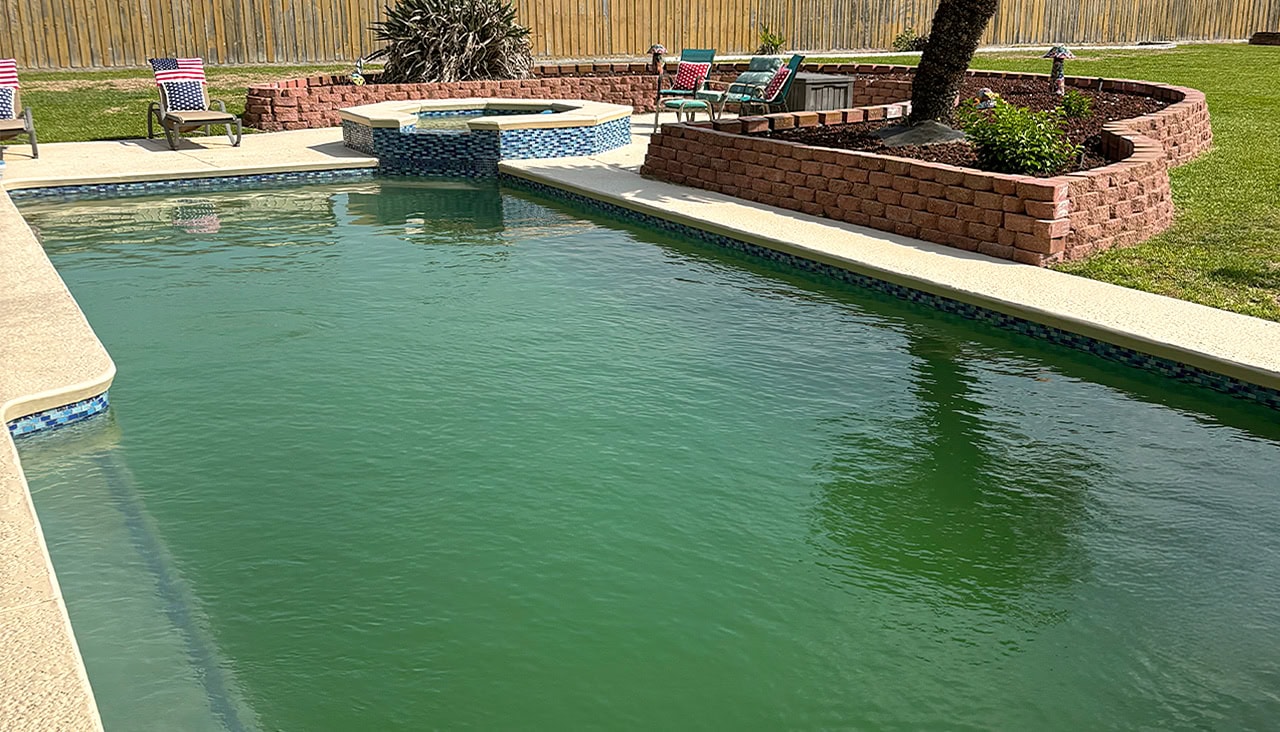
Algae is the number one enemy of Texas pool owners. It grows fast, spreads aggressively, and turns a beautiful backyard pool into something you don't want to go near — often in less time than most homeowners expect. One week of skipped service, one stretch of intense summer heat, one heavy rainstorm that dilutes your chemistry, and algae finds the opening it needs to take hold.
But not all pool algae is the same. Green algae, yellow algae, black algae — each type behaves differently, responds to different treatments, and requires a different level of effort to eliminate. Knowing which type you're dealing with is the difference between fixing the problem in 48 hours and fighting it for weeks without making real progress.
This guide covers every major type of pool algae found in Texas pools, what causes each one to develop, how to kill it effectively, and what the consistent habits are that keep all types of algae from coming back.
Texas creates near-perfect conditions for pool algae growth — and understanding why helps you appreciate why consistent prevention matters more here than in almost any other state.
Intense heat and UV exposure. Algae thrives in warm water. Texas pools regularly reach water temperatures of 85–90 degrees or higher during summer — temperatures where algae reproduction accelerates dramatically. The same UV exposure that burns through chlorine rapidly is also the energy source that drives algae photosynthesis in outdoor pools.
Long swim seasons. Texas pools are in active use for 8–10 months of the year in most parts of the state. That's 8–10 months of bather load introducing organic contaminants, consuming chlorine, and creating the conditions pool algae needs to grow. Northern pools get a winter break from algae pressure. Texas pools do not.
Heavy pollen and organic material. Texas spring brings massive pollen loads that settle directly into pool water. Organic material — pollen, leaves, insects, airborne debris — provides nutrients that feed pool algae. A pool surrounded by trees during spring pollen season is under constant algae pressure that demands consistent chemical maintenance.
Rain and chemistry disruption. Texas storms are significant. Heavy rain dilutes pool chemistry across the board — lowering chlorine, dropping pH, reducing alkalinity — creating exactly the conditions where pool algae goes from dormant spores to visible growth rapidly. Without post-storm chemistry adjustment, algae often blooms within 24–48 hours of a heavy rain event.
Hard water. Texas tap water is mineral-heavy, which creates water chemistry that requires more active management to keep balanced. Chemistry that drifts out of range in hard-water conditions creates more favorable conditions for pool algae than properly balanced water.
Green Pool Algae
Green pool algae is by far the most common type Texas homeowners encounter. It's the algae responsible for cloudy green water, slippery walls, and the swamp-like appearance that shows up after a week of neglected chemistry or a heavy rainstorm.
Green pool algae floats freely in the water as well as attaching to pool surfaces — which is why it turns the entire water volume green rather than just discoloring surfaces. It spreads rapidly in warm water when chlorine levels drop below effective levels, and it can take a pool from clear to visibly green in as little as 24–48 hours under the right Texas summer conditions.
Green pool algae is the easiest type to treat — but only if you catch it early. A light green tint or slight haziness responds well to a strong shock treatment, thorough brushing, and continuous filtration over 24–48 hours. A full dark green bloom with significantly reduced visibility requires heavier intervention — multiple shock treatments, extended filtration, and potentially professional service to recover completely.
What causes green pool algae:
Yellow Pool Algae (Mustard Algae)
Yellow pool algae — commonly called mustard algae because of its yellowish-brown color — is significantly more difficult to eliminate than green algae and one of the most frustrating pool problems Texas homeowners face. It appears as a yellowish, dusty or powdery coating on pool walls, steps, and floor — particularly in shaded areas and corners with reduced water circulation. It brushes off easily but comes right back within hours if not treated aggressively.
The reason mustard algae is so hard to kill is chlorine resistance. Yellow pool algae has a much higher tolerance for chlorine than green algae — standard shock doses that would eliminate a green algae bloom often have minimal effect on mustard algae. It also lives on pool surfaces, equipment, and accessories — including pool toys, brushes, nets, and even swimwear — which means it reintroduces itself to the pool after treatment if those items aren't sanitized as part of the elimination process.
Yellow pool algae is more common in Texas than most homeowners realize — it's frequently mistaken for sand, dirt, or pollen deposits until it keeps coming back despite cleaning.
What causes yellow pool algae:
Black Pool Algae
Black pool algae is the most difficult type to treat and the one that requires the most aggressive, sustained intervention to eliminate. Despite the name, it appears as dark blue-green or black spots — typically on plaster or concrete pool surfaces, in cracks and grout lines, on steps, and in shaded areas of the pool.
What makes black pool algae so resistant to treatment is its structure. Unlike green or yellow algae that float freely or attach loosely to surfaces, black pool algae forms deeply rooted colonies with a protective outer layer — a biofilm or slime cap — that shields the algae from chlorine penetration. You can shock the pool heavily and the outer layer will die and turn gray or white — but the living algae beneath the protective cap survives and regenerates within days.
Black pool algae also penetrates plaster surfaces, growing roots down into the pool shell itself. This is why simply brushing or shocking over black pool algae doesn't eliminate it — the treatment has to physically disrupt the protective cap and penetrate into the surface where the algae is rooted.
Black pool algae is primarily a problem in plaster and concrete pools — it rarely establishes in fiberglass or vinyl liner pools because its roots can't penetrate those surfaces the same way.
What causes black pool algae:
Treating Green Pool Algae
Green pool algae treatment is the most straightforward of the three types — but it needs to be done thoroughly and in the right sequence to work.
Step 1 — Test and adjust chemistry. Before shocking, test pH and bring it into the 7.2–7.4 range. Shock treatment is dramatically more effective at proper pH — adding shock to water with high pH wastes chemical and slows recovery significantly.
Step 2 — Brush all surfaces. Brush walls, floor, steps, and corners thoroughly before adding shock. Brushing breaks up algae colonies and exposes them to the chemical treatment you're about to add.
Step 3 — Shock heavily. For light green pool algae, use 2 pounds of calcium hypochlorite shock per 10,000 gallons. For medium green water with reduced visibility, double that dose. For dark green water with no visibility, triple the standard dose and plan for multiple treatment rounds. Add shock at dusk for maximum effectiveness.
Step 4 — Run the filter continuously. Keep the pump and filter running 24 hours a day during green pool algae recovery. Check and clean the filter every 8–12 hours — a clogged filter during recovery defeats the treatment. Dead algae particles are what make the water cloudy after shocking — they need to be filtered out for clarity to return.
Step 5 — Retest and repeat if needed. Check chemistry after 24 hours. If the water is lightening and chlorine is holding above 1 ppm, you're on track. If the water is still dark green and chlorine has dropped back to zero, shock again. Severe green pool algae blooms may require 3–4 treatment cycles over several days.
Step 6 — Add clarifier. Once the algae is dead and the water is clearing, a clarifier helps the filter capture fine dead algae particles that are causing residual cloudiness. Run the filter continuously and clean it frequently during this final clearing phase.
Treating Yellow Pool Algae (Mustard Algae)
Yellow pool algae requires a more aggressive and more specific treatment approach than green algae.
Step 1 — Remove and sanitize everything. Before treating the pool, remove all pool accessories — toys, floats, nets, brushes, vacuum heads — and sanitize them with a diluted bleach solution. Any contaminated item returned to the pool after treatment will reintroduce yellow pool algae and restart the infestation.
Step 2 — Brush aggressively. Yellow pool algae is surface-attached. Brush every affected surface vigorously — walls, floor, steps, corners, behind ladders, and anywhere you see the yellowish discoloration. This disturbs the algae and prepares it for chemical treatment.
Step 3 — Apply a mustard algae-specific treatment. Standard pool shock alone is often insufficient for yellow pool algae. Use a mustard algaecide or yellow algae treatment product designed specifically for this type — apply it directly to affected areas while brushing it in.
Step 4 — Shock at triple the standard dose. Yellow pool algae requires significantly higher chlorine concentrations to penetrate its chlorine resistance. Use triple the standard shock dose — 6 pounds of calcium hypochlorite per 10,000 gallons — and add it with the pump running.
Step 5 — Run the filter continuously and clean it frequently. Just as with green algae treatment, continuous filtration and frequent filter cleaning are essential during yellow pool algae recovery.
Step 6 — Rebrush after 24 hours. Come back the next day and brush all surfaces again. Yellow pool algae that appeared to be gone after the initial shock often shows residual presence that needs a second round of brushing and treatment.
Step 7 — Follow up with preventative algaecide. Once yellow pool algae is eliminated, add a quality preventative algaecide to your regular pool care routine. Yellow algae recurrence is extremely common in pools that don't use preventative algaecide after a mustard algae treatment.
Treating Black Pool Algae
Black pool algae is a multi-week project that requires persistence and the right approach. Don't expect results in 24 hours — this type of pool algae fights back.
Step 1 — Identify all affected areas precisely. Before treating, map out every spot where black pool algae is present — spots, streaks, colonies in grout lines, patches on steps. You need to treat every single colony completely — any surviving black pool algae will regenerate a new bloom from the roots.
Step 2 — Brush with a steel wire brush. Standard nylon pool brushes cannot penetrate the protective cap of black pool algae effectively. Use a stainless steel wire brush on plaster surfaces to physically break through the slime cap and expose the living algae beneath to chemical treatment. This step is non-negotiable — brushing without penetrating the cap means your chemical treatment has no path to the living algae.
Step 3 — Apply trichlor tablets directly to colonies. After wire brushing, rub a trichlor tablet directly on each black pool algae colony. The high-concentration chlorine applied directly to the disturbed surface delivers far more chemical impact than dissolved shock in the water. Do this for every colony — don't skip spots.
Step 4 — Shock the pool heavily. Add a heavy shock dose — at minimum triple the standard amount — at dusk after direct treatment of all colonies. Adjust pH to 7.2 first for maximum effectiveness.
Step 5 — Repeat the entire process every 3–5 days. Black pool algae treatment is not a one-time event. Repeat the wire brushing, direct tablet application, and shock treatment every 3–5 days until no new black pool algae regrowth appears between treatments. Expect this process to take 2–4 weeks for a significant infestation.
Step 6 — Assess surface condition after treatment. Severe black pool algae infestations that have been present for an extended time may have penetrated the plaster deeply enough that complete elimination requires resurfacing. If black pool algae keeps returning despite aggressive repeated treatment, a professional assessment of the pool surface condition is the next step.
Prevention is always easier than treatment when it comes to pool algae. Here's what consistent algae prevention looks like for Texas pools:
Maintain chlorine between 1–3 ppm consistently. This is the single most important algae prevention habit. Pool algae cannot establish in water with adequate free chlorine — it only gets its opening when chlorine drops. Test weekly and adjust immediately when chlorine falls below 1 ppm.
Keep pH in the 7.2–7.6 range. High pH renders chlorine less effective even when levels look adequate — and that reduced effectiveness creates the conditions pool algae needs. pH management is algae prevention.
Maintain cyanuric acid between 30–50 ppm. Without stabilizer, chlorine burns off rapidly in Texas sunlight and pool algae finds its opening within hours. Cyanuric acid protection is non-negotiable for outdoor Texas pools.
Brush weekly. Brushing disrupts early algae biofilm before it becomes visible pool algae. Ten minutes of brushing every week prevents the vast majority of algae blooms that develop from established surface colonies.
Shock weekly during swim season. Regular weekly shocking eliminates combined chlorine, oxidizes organic contaminants, and resets sanitizer levels — dramatically reducing pool algae's ability to establish between service visits.
Use preventative algaecide. A quality algaecide added monthly during swim season provides an additional chemical barrier against pool algae that supplements chlorine. In Texas where algae pressure is year-round, preventative algaecide is a worthwhile addition to any pool care routine.
Test and adjust after every significant rain. Post-rain chemistry correction is one of the most impactful pool algae prevention habits for Texas pool owners. Rain dilutes everything simultaneously — and the chemistry window it opens is exactly when pool algae strikes fastest.
Keep the filter clean and running adequately. A clean filter running 8–10 hours daily during Texas summer maintains the circulation and filtration that prevents dead spots where pool algae establishes first.
Most green algae situations and many mustard algae cases can be managed by informed, persistent homeowners. But there are circumstances where professional pool algae treatment is the right call:
The water is dark green and you've already shocked twice without improvement. Something is preventing the treatment from working — a filtration problem, severe pH imbalance, or algae that's more entrenched than standard treatment can address. Professional diagnosis finds the real obstacle.
You're dealing with black pool algae for the first time. Black pool algae treatment done incorrectly — using nylon brushes, insufficient shock, skipping colonies — creates resistant algae that's even harder to eliminate on the second attempt. Starting with professional treatment gives you the best chance of complete elimination.
Algae keeps coming back every few weeks despite treatment. Recurring pool algae despite consistent chemistry management points to an underlying issue — a circulation dead spot, a contamination source, inadequate stabilizer, or a surface condition that's harboring algae — that a professional evaluation can identify and address.
You don't have time for a multi-week black algae treatment. Black pool algae requires sustained effort over several weeks. Professional pool algae service handles the repeated treatments, documentation, and assessment that the process demands.

Whether you're dealing with pool algae right now or you want a service program that makes sure it never becomes your problem — CK Pools is ready to help.
Ready to get your pool algae-free and keep it that way? Request your free quote at ckpools.com/contact and let CK Pools handle the algae so you never have to.