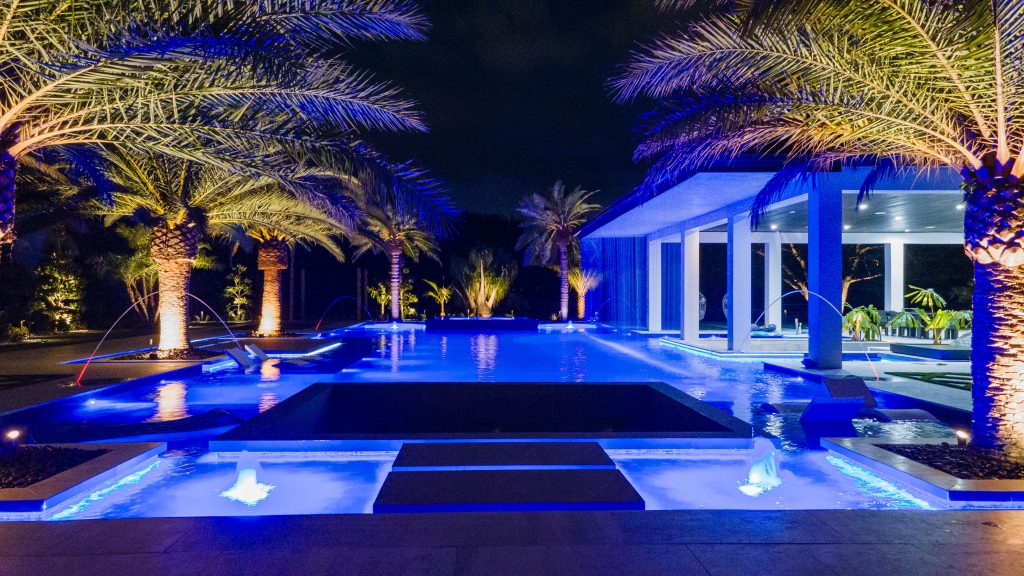
There's a moment that happens the first time a homeowner turns on a well-lit pool after dark — and it never gets old. The water glows. The color shifts slowly from blue to purple to green. The waterfall catches the light differently than it does in daylight. The whole backyard transforms from a daytime amenity into something that looks genuinely resort-quality at night. And the homeowner who's been swimming in that pool for five years suddenly wonders why they waited this long to upgrade the lighting.
Pool lighting is one of the highest visual-impact, lowest-disruption upgrades available in pool remodeling — and in Texas, where backyard entertaining extends well into fall evenings and pools see use after dark regularly through the long swim season, good lighting isn't just aesthetic. It's a safety requirement, a functional necessity, and the upgrade that makes a pool as impressive at 9pm as it is at 3pm.
This guide covers everything Texas homeowners need to know about pool lighting — what options are available, how LED technology has changed the game, what pool lighting costs, and how CK Pools approaches lighting upgrades as part of pool remodeling and equipment service.
Texas pools are used differently than pools in shorter-season states — and that usage pattern makes lighting more important here.
Evening swimming is the norm in Texas summer. When afternoon temperatures in Houston, Dallas, and San Antonio regularly exceed 95–100 degrees, peak pool use shifts toward evening. Families who would overheat swimming at 4pm are in the pool at 7pm when temperatures have dropped to the low 80s. Evening swimming in a pool without adequate lighting is uncomfortable at best and unsafe at worst — you can't see the pool floor, depth changes aren't visible, and the pool environment that's inviting in daylight becomes disorienting after dark.
Outdoor entertaining extends into fall. Texas fall evenings are some of the most pleasant outdoor conditions in the country — and Texas homeowners take full advantage with outdoor entertaining that continues well past sunset. A pool that's lit beautifully becomes the centerpiece of that entertaining rather than a dark, underutilized feature at the edge of the yard.
Long swim seasons mean more after-dark use hours. A Texas pool that's used from March through October accumulates significantly more evening use hours than a pool in a four-month swim season state. More evening use hours means pool lighting isn't an occasional-use feature — it's in regular service for a substantial portion of every week during the season.
LED pool lights are the current standard for pool lighting — and for every meaningful performance metric, they're superior to the incandescent and halogen fixtures they've replaced. If your pool still has incandescent or halogen lighting, upgrading to LED is one of the most universally recommended pool lighting improvements available.
What makes LED pool lighting different:
Energy efficiency. LED pool lights use 75–85% less electricity than equivalent incandescent fixtures producing the same light output. A standard 500-watt incandescent pool light running 4 hours per evening consumes 2 kilowatt-hours per day. An equivalent LED fixture uses 70–100 watts — consuming roughly 0.3–0.4 kilowatt-hours for the same 4 hours of operation. For Texas pools where pool lighting runs regularly through a long swim season, this efficiency difference translates to $80–$150 per year in electricity savings from lighting alone.
Service life. Incandescent pool light bulbs have service lives of 1,000–2,000 hours — meaning a pool light running 4 hours per evening through a 200-day Texas swim season needs bulb replacement every 1–2 years. LED pool light fixtures have rated service lives of 30,000–50,000 hours — meaning the fixture installed today may still be operating when the pool next needs resurfacing. LED pool lighting essentially eliminates the recurring bulb replacement cost and inconvenience that incandescent lighting requires.
Color capability. This is where LED pool lighting transforms the pool experience. While incandescent lights produce only white light — and colored incandescent lights use colored lenses that dim the output significantly — LED pool lights produce vibrant, full-spectrum color through the diodes themselves. Modern LED pool light fixtures offer programmable color options — fixed colors, color-changing sequences, synchronized shows — that transform the visual character of the pool completely.
A pool with color-capable LED lighting looks dramatically different at night than the same pool with white incandescent lighting. The ability to set the pool to a deep blue for a relaxed evening swim, shift to a vibrant color show during a party, or match pool lighting to outdoor décor colors is a feature that pool owners with color LED lighting consistently name as one of their favorite amenities.
Heat output. Incandescent bulbs convert a significant portion of their energy consumption to heat rather than light. Inside a pool light niche, this heat creates thermal stress on the gasket and lens components, accelerating wear and increasing the frequency of seal failures that allow water into the niche. LED pool lights run cool — dramatically reducing the thermal stress on light niche components and contributing to the extended service life of the overall fixture.
Fiber optic pool lighting uses a remote illuminator — a light source located outside the pool — to transmit light through flexible fiber optic strands to light points in the pool structure. The fiber strands themselves don't carry electricity — only light — which means there's no electrical component inside the water at all.
The safety advantage: The complete absence of electrical components inside or near the water is fiber optic's primary differentiator. In pools where electrical safety is a primary concern — particularly pools with aging wiring that hasn't been fully evaluated, or pools where GFCI protection and bonding are uncertain — fiber optic lighting offers a genuinely electricity-free in-pool lighting option.
Performance limitations: Fiber optic pool lighting produces less light output than LED fixtures — the transmission of light through fiber strands reduces intensity compared to a direct LED source. For pool lighting that's intended to illuminate the pool interior for visibility and safety, fiber optic systems may not provide adequate light output in larger pools. They're more suitable as accent lighting — illuminating specific features, creating star effects in pool floors or walls, or providing ambient color lighting — than as primary pool illumination.
Cost and maintenance: Fiber optic pool lighting systems are generally more expensive to install than LED systems of equivalent output. The illuminator unit — the light source — requires periodic bulb replacement (if not LED-based) and is a potential failure point. Fiber strands in pool structures can be difficult to replace if damaged.
Within LED pool lighting, there's an important distinction between traditional niche-mounted fixtures and newer nicheless LED designs:
Traditional niche-mounted LED fixtures install in a pre-existing concrete niche in the pool wall — the same niche that housed the previous incandescent light. For pools with existing niche infrastructure, upgrading to LED is a straightforward lamp or fixture swap that doesn't require major construction. The niche provides a watertight housing for the fixture with conduit that routes wiring safely out of the water.
Traditional niche upgrades are the most common LED pool lighting installation type for existing Texas pools — the existing infrastructure makes installation efficient and cost-effective.
Nicheless LED fixtures are smaller, lower-profile fixtures that install directly in the pool wall without a traditional niche housing. They're used in new pool construction where niche locations are pre-planned, and in certain remodeling situations where additional lighting points are being added beyond existing niche locations.
Nicheless fixtures allow more flexible placement of additional pool lighting points — in steps, along benches, at the waterline, or in specific feature areas — without the construction required to add full niches. They're particularly popular for accent lighting applications in Texas pool remodeling projects.
Beyond the main pool lighting fixtures, underwater feature lighting addresses specific architectural elements that benefit from dedicated illumination:
Waterfall and water feature lighting. Waterfalls, sheer descents, and fountains look dramatically different — and dramatically better — when lit from below or behind. Dedicated LED fixtures installed in waterfall structures, behind sheer descent blades, or at the base of water features create the illuminated water effect that makes water features genuinely spectacular after dark. This is one of the most impactful pool lighting upgrades for Texas pools with existing water features that have never been lit properly.
Step and bench lighting. Safety lighting for pool steps and benches provides both functional visibility and visual accent. Small LED step lights installed in pool step risers or bench faces illuminate transitions and create a layered lighting effect that looks intentionally designed rather than simply functional.
Sun shelf and tanning ledge lighting. LED lighting installed in the floor of sun shelves — the shallow tanning areas that have become standard in Texas custom pools — creates a beautiful glowing shallow water effect that makes the feature as visually interesting at night as it is during the day.
Complete pool lighting design includes elements beyond what's in the water:
Deck and hardscape lighting. Low-voltage LED fixtures installed in pool deck surfaces, along steps, under coping, or in retaining walls create ambient illumination that extends the pool lighting design beyond the water itself. Well-designed deck lighting makes the entire pool area safer to navigate after dark and creates a cohesive nighttime aesthetic.
Landscape uplighting. Uplighting installed at the base of palms, live oaks, or other landscape elements surrounding the pool creates depth and visual interest in the nighttime backyard environment. Landscape lighting that frames the pool area elevates the entire outdoor space — not just the pool.
Pool perimeter and pathway lighting. Lighting the perimeter of the pool deck and pathways leading to the pool serves both safety and aesthetic functions — guiding movement safely while contributing to the overall visual design of the nighttime pool environment.
Pool lighting cost varies based on the scope of the project, the number of fixtures, the technology selected, and whether the installation is straightforward fixture replacement or involves new wiring, conduit, or niche construction.
Single LED fixture replacement — replacing one existing incandescent niche fixture with an LED color fixture — is the most accessible pool lighting upgrade and typically costs $300–$600 installed depending on fixture brand and any wiring work required.
Full pool LED lighting upgrade — replacing all existing fixtures with new LED color fixtures, including any transformer or control system updates required — typically runs $800–$2,000 for most Texas residential pools depending on the number of fixtures and the control integration involved.
Automation integration — connecting pool lighting to a pool automation system for app control, color programming, and scheduling — adds $200–$500 to the lighting upgrade cost but delivers the full LED color experience that makes the upgrade genuinely transformative.
Feature lighting additions — adding underwater LED fixtures to waterfall structures, step systems, or sun shelves that weren't previously lit — runs $500–$1,500 per feature area depending on the construction required to route wiring and install fixtures in existing pool structures.
Complete pool lighting design — a comprehensive lighting project that includes new LED pool fixtures, feature lighting, deck lighting, and landscape lighting integrated with a pool automation system — can range from $3,000–$8,000 or more depending on scope for a complete Texas backyard pool environment.
How do you know when pool lighting has moved from adequate to overdue for an upgrade? Here are the signals:
Your pool still has incandescent fixtures. If your pool lighting is incandescent or halogen — indicated by high electricity consumption, frequent bulb replacement, and white-only light output — every month you continue operating those fixtures is a month you're paying 4–5 times the electricity cost of equivalent LED lighting. The upgrade pays for itself in electricity savings typically within 2–4 years.
You're replacing bulbs every 1–2 seasons. Frequent incandescent bulb replacement is the clearest signal that LED conversion delivers immediate practical value — you trade the ongoing recurring cost and inconvenience of bulb replacement for a fixture that won't need attention for decades.
Water keeps getting into the light niche. A light niche that repeatedly allows water intrusion — indicated by the breaker tripping when the light is turned on, a light that flickers or goes out intermittently, or visible moisture when the niche is opened — has a seal integrity problem. LED fixture replacement at the same time as niche seal repair addresses both issues simultaneously and sets the niche up for the extended service life that LED's lower heat output enables.
Your pool lighting is white-only. If your pool has functional, energy-efficient LED lighting but it's white-only — an early LED generation that didn't include color capability — upgrading to current color LED fixtures is a relatively modest investment that dramatically changes the nighttime pool experience.
You've added water features that aren't lit. A waterfall or fountain that was added during a remodel but never received dedicated lighting is an underutilized visual asset. Adding feature lighting to existing water features is one of the highest-impact, lowest-disruption pool lighting upgrades available.
Pool lighting upgrades are one of the most satisfying service categories CK Pools handles — the transformation from dated incandescent lighting to full-color LED with automation integration is immediate, visible, and consistently produces the reaction homeowners who've been on the fence about upgrading wish they'd made sooner.
CK Pools handles pool lighting upgrades as part of both equipment service — straightforward LED fixture replacements for pools with aging incandescent systems — and as part of comprehensive pool remodeling projects where lighting is integrated into a broader aesthetic vision for the pool environment.
Every pool lighting project starts with an honest assessment of what's currently installed, what the upgrade options are, and what the installation actually involves — with clear pricing and your full approval before any work begins. No unnecessary wiring upgrades recommended when a straightforward fixture swap is all that's needed. No overselling of automation features that don't match the pool owner's usage patterns.

With over 37 years of experience transforming Texas pools — and direct familiarity with the specific lighting products and installation approaches that perform best in Texas conditions — CK Pools delivers pool lighting results that Texas homeowners are genuinely excited about.
Ready to see what your pool looks like after dark? Request your free pool lighting consultation at ckpools.com/contact and let CK Pools show you what the right lighting does to a Texas pool at night.