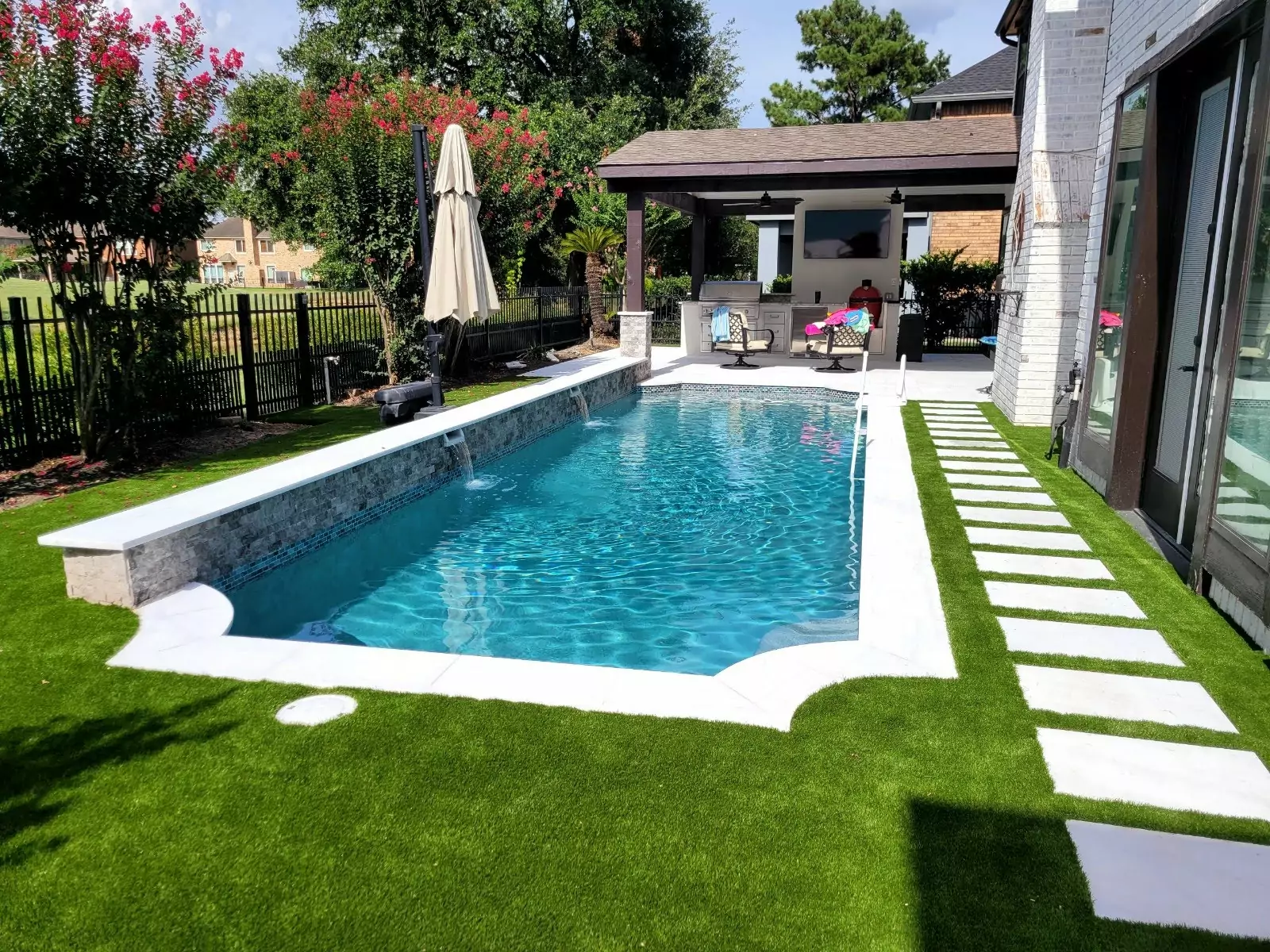
At some point, every Texas homeowner with an aging pool faces a version of the same question. The surface is worn. The equipment is dated. The design feels like it belongs to a different era of the house. Maybe it's been leaking. Maybe the deck is cracked and settling. Maybe the kids are older now and the pool that was designed around a young family doesn't fit the way the backyard gets used anymore.
The question isn't whether something needs to change — it's which direction to go. Renovate what's there, or start over with something new? It's one of the biggest financial decisions in residential pool ownership, and it's one that gets made emotionally far more often than it gets made analytically. The homeowner who tears out a perfectly restorable pool because they wanted something new spends significantly more than necessary. The homeowner who sinks renovation money into a structurally compromised pool spends money on a foundation that was going to fail anyway.
This guide gives Texas homeowners the honest framework for making this decision correctly — what factors point toward renovation, what factors point toward replacement, what each path actually costs, and how CK Pools approaches the evaluation that leads to the right recommendation for each specific situation.
Before comparing renovation to replacement, it's important to understand what pool renovation actually encompasses — because many homeowners think of renovation as just resurfacing when it's actually a comprehensive service category that can address almost every aspect of an aging pool.
Surface restoration. The most common renovation component — removing the existing interior finish and applying new plaster, quartz, or pebble aggregate. A pool that looks dated and feels rough can be transformed visually and functionally with a resurfacing that takes 5–10 days and leaves the pool looking essentially new from the inside.
Tile and coping replacement. Swapping outdated or deteriorated tile and coping is one of the highest visual-impact renovation components — the waterline and edge of the pool are the first things people see, and updated tile and coping modernizes the pool's appearance dramatically even without touching the interior finish.
Deck renovation. Resurfacing, replacing, or upgrading the pool deck transforms the entire outdoor environment around the pool — not just the pool itself. A dated brushed concrete deck replaced with travertine or pavers changes the character of the backyard completely while addressing the cracking, staining, or surface deterioration that made the old deck an eyesore.
Equipment upgrades. Replacing aging pumps, filters, heaters, and automation systems with modern, efficient equipment improves performance, reduces operating costs, and extends the useful service life of the renovated pool significantly. A pool with new surfaces and new equipment is functionally comparable to a new pool at a fraction of the replacement cost.
Adding features. Water features, lighting upgrades, sun shelves, automation, and other modern amenities can all be added to existing pools as part of a renovation — transforming a basic rectangular pool built in the 1990s into a feature-rich contemporary backyard amenity that reflects how pools are designed today.
Structural repairs. Pool renovation can include repairing cracks, addressing bond beam issues, fixing plumbing problems, and correcting structural deficiencies — making renovation a viable path even for pools that have developed physical problems beyond surface wear.
Pool replacement — demolishing the existing pool and building a new one — is the right answer in specific circumstances, but it's a significantly larger and more disruptive undertaking than renovation in almost every case.
Demolition. Removing an existing inground pool involves breaking up the shell — typically with jackhammers for concrete pools — removing the debris, backfilling the excavation with compacted fill, and preparing the site for new construction. Demolition alone is a significant cost that doesn't exist in renovation.
Full new construction. After demolition, building a new pool follows the same process as any new pool construction — excavation, steel and plumbing, shotcrete or gunite, finish work, equipment installation, and startup. All of the new pool construction cost applies in addition to the demolition cost.
Disruption timeline. Pool replacement takes significantly longer than renovation — demolition, site preparation, new construction, and startup typically requires 3–5 months total. Renovation projects, even comprehensive ones, typically complete in 3–8 weeks depending on scope. For Texas homeowners who use their pool regularly, the extended downtime of a replacement versus the shorter disruption of renovation is a meaningful quality-of-life consideration.
Landscaping and deck. Pool replacement almost always requires removing and replacing all surrounding deck and landscaping — the construction process disturbs everything around the pool. Renovation, particularly surface and equipment-focused renovation, can often preserve much of the existing deck and landscaping.
Pool renovation is the right path in the vast majority of situations where Texas homeowners are evaluating aging pools. Here's specifically when renovation makes clear sense:
The pool shell is structurally sound. A pool with a solid, crack-free or repairable shell that holds water without significant loss has the structural foundation for successful renovation. When the shell is sound, surface wear, equipment age, design datedness, and feature limitations are all renovation problems — not replacement problems.
The pool's location and size still work. If the pool's position in the yard, its size, and its basic shape still make sense for how the property is used — renovation can transform the pool's appearance and performance without the disruption and cost of building in a different configuration.
The pool has specific, addressable problems. Equipment that's aging, a surface that's deteriorated, tile that's outdated, a deck that needs replacement, water features that are absent or inadequate — these are all renovation problems with renovation solutions. A pool with a list of specific addressable issues is a renovation candidate.
The pool's design can be updated through renovation. Many Texas homeowners feel their pool looks dated — but "dated" is often a renovation conversation, not a replacement one. Updating tile, coping, and deck materials, adding water features and LED lighting, and refinishing with a contemporary surface color can transform a 1990s pool into something that looks and feels current without demolishing the structure.
Budget favors renovation. A comprehensive pool renovation — including resurfacing, new tile and coping, deck replacement, equipment upgrades, and water feature additions — typically costs $30,000–$80,000 depending on scope. A new pool construction that delivers the same result costs $80,000–$150,000 or more. When the renovated pool delivers the desired result, the cost differential between renovation and replacement is the clearest argument for renovation.
Pool replacement is warranted in specific circumstances — and being honest about those circumstances is what protects homeowners from investing renovation money in a pool that isn't a viable renovation candidate.
Severe, irreparable structural damage. A pool with structural cracking so extensive — from severe soil movement, tree root intrusion, or long-term neglect — that the shell cannot be effectively repaired is a replacement candidate. If the structural repairs required to stabilize the shell approach or exceed the cost of replacement, the economics of renovation disappear. CK Pools evaluates structural condition honestly during every renovation consultation — and recommends replacement when the structural situation makes renovation an economically irrational choice.
The pool's location or configuration is genuinely wrong for the property. Sometimes a pool was built in a location that limits yard use, blocks light to the house, or is simply wrong for how the property functions — and no renovation changes that fundamental problem. If the pool's location is the issue, renovation doesn't solve it. Replacement with a pool in a better location, different size, or different configuration does.
The pool is simply too small for current needs. A pool built for a young family in a 10x20 configuration that now needs to serve a household that entertains regularly and wants lap swimming capability cannot be made larger through renovation. Pool expansion — adding water volume to an existing shell — is technically possible in limited circumstances but is rarely cost-effective compared to replacement. When size is the core limitation, replacement delivers what renovation can't.
Renovation cost approaches replacement cost for the specific pool. For pools with significant structural issues that require extensive repair in addition to surface, equipment, and feature work, renovation costs can approach replacement costs for that specific pool. When the renovation quote is within 60–70% of a new pool quote for the same result, the calculation shifts — the incremental cost of replacement versus renovation buys a new pool with full modern engineering, new plumbing, new structure, and a new service life horizon.
The pool design is incompatible with the desired result. A very old, very basic rectangular pool that a homeowner wants to transform into a resort-style freeform pool with a grotto, sun shelf, and extensive water features may be better served by replacement than renovation — the renovation scope required to achieve the desired result may approach or exceed replacement cost while leaving behind an older structural shell rather than a purpose-built new one.
Here's an honest cost framework for comparing renovation and replacement in Texas markets:
Comprehensive pool renovation — resurfacing, tile and coping, deck replacement, equipment upgrades, water features, and lighting: $35,000–$80,000 depending on scope and market.
New pool construction — comparable size and features to the renovated pool, on the site of the demolished existing pool: $90,000–$150,000+ including demolition.
The cost differential between renovation and replacement for equivalent outcomes is typically $50,000–$80,000 — a difference that, for most Texas homeowners, makes renovation the financially rational choice whenever the pool is structurally viable and the desired result is achievable through renovation.
The cases where this math shifts are specifically when renovation scope is so extensive — due to severe structural damage or fundamental design incompatibility — that renovation cost approaches replacement cost. In these situations the incremental investment in replacement buys a new pool with new engineering and a new service life rather than an extensively renovated old pool with an aging structural foundation.
CK Pools has been renovating and building pools across Texas for over 37 years — and the team has performed both evaluations enough times to know that the honest answer isn't always the most profitable one for the contractor. A pool that can be successfully renovated doesn't need to be replaced, and recommending replacement when renovation is the right answer isn't the kind of relationship CK Pools builds with Texas homeowners.
Every renovation versus replacement evaluation from CK Pools starts with a thorough structural assessment — looking at the shell condition, the plumbing integrity, the equipment state, and the site conditions — before any recommendation is made. The evaluation produces one of three findings:
Clear renovation candidate — the pool is structurally sound, the desired result is achievable through renovation, and the renovation cost is substantially lower than replacement. CK Pools provides a detailed renovation scope and pricing.
Renovation with structural repair — the pool has structural issues that need addressing as part of the renovation but remains a viable renovation candidate. CK Pools provides a renovation scope that includes the structural repair work needed to make the renovation result durable and long-lasting.
Replacement recommendation — the structural condition, configuration limitations, or renovation-to-replacement cost ratio makes replacement the honest recommendation. CK Pools provides both a renovation scope (for homeowners who want to see the comparison) and a replacement quote so the decision can be made with full information.
What CK Pools never does is recommend replacement when renovation is the right answer — or recommend renovation when structural reality makes it a poor investment. The evaluation is honest, the recommendation is based on the pool's actual condition and the homeowner's actual goals, and the decision belongs to the homeowner with full information.

Every renovation or replacement project starts with a thorough evaluation, clear options, transparent pricing, and your full approval before any work begins. No pressure toward the more expensive option. No renovation of pools that need replacement. No replacement of pools that renovation can restore.
Ready to figure out what your pool actually needs? Request your free renovation evaluation at ckpools.com/contact and let CK Pools give you the honest assessment that helps you make the right call.